Boston Dynamics’ Atlas fitted with wheels to stress actuators and test whole-body RL (source date: 2026-11-09)
AI-assisted source briefing. Boston Dynamics retrofitted wheels onto Atlas as a research testbed to push motor and control limits, run whole-body reinforcement learning policies in simulation and hardware, and study sim-to-real transfer and emergent wheeled behaviors.
Published by The Humanoid Race
Source link: bostondynamics.com
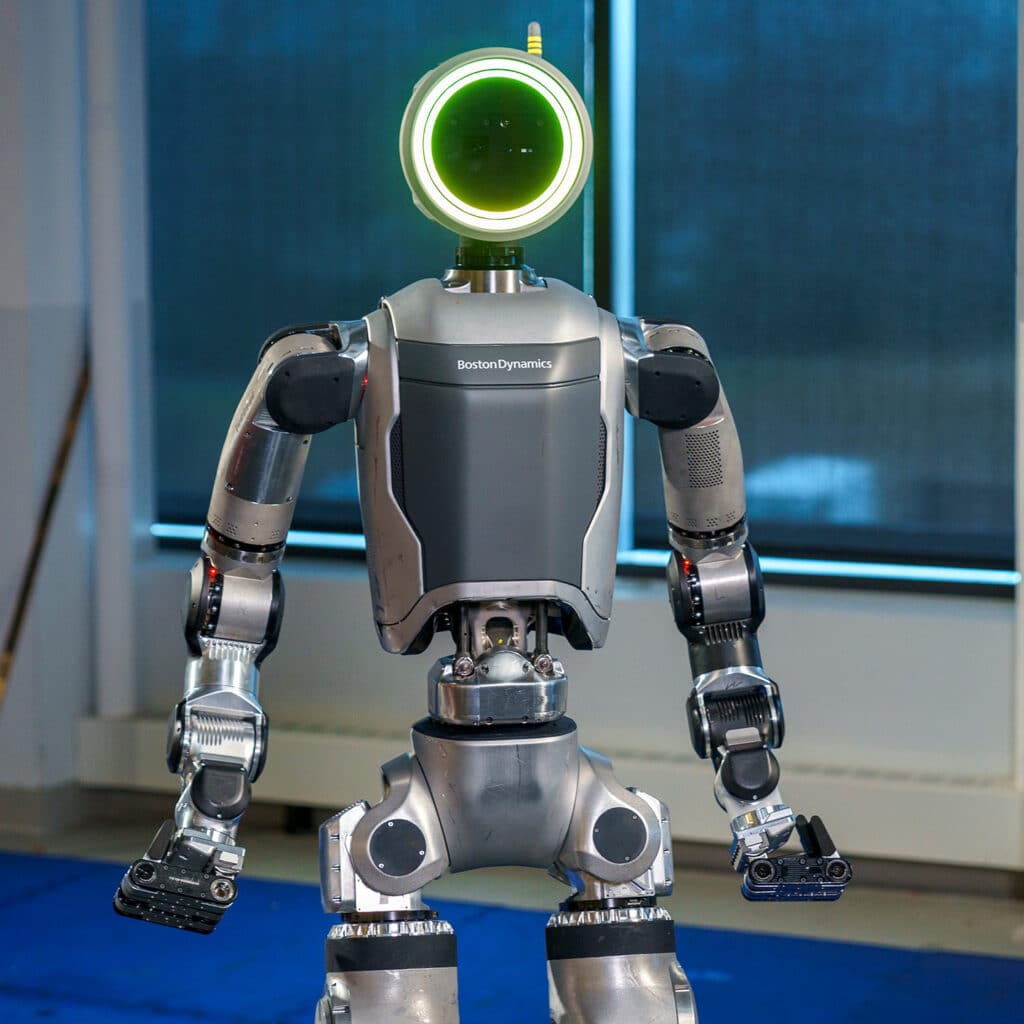
AI-assisted source briefing. Automatically written and checked against the cited source, without human editorial review. These are automated checks, not independent verification. Evidence date: 2026-11-09. Classification: reported actual. Boston Dynamics reports that its Atlas humanoid had its feet swapped for wheels to create a research testbed that stresses actuators and control software; the team says the retrofit was intentionally aimed at driving motors continuously across high torque and speed ranges rather than to become a product (the company characterizes the wheeled Atlas as a research testbed, not a product). The physical conversion was described as mechanically simple: engineers mounted an off‑the‑shelf scooter rim to Atlas’ existing ankle actuator with a single custom adapter, and the company says the hardware change was about as involved as swapping a bicycle wheel; in software each wheel was modeled as a continuously spinning “ankle,” letting the baseline robot model be reused with the feet replaced by wheels. Boston Dynamics combined classical motor‑control characterization with whole‑body reinforcement learning (RL). The team tuned low‑level control parameters and simulated motor models to better match measured hardware behavior, then trained policies in simulation before running them on the robot in hardware, with the company emphasizing this work as an exercise in closing the sim‑to‑real gap. In demonstrations the company reports the simulation‑trained policies transferred to hardware with notable results: a 360‑degree jump trajectory pulled from human motion capture worked on the first try, and the policy learned to use wheels to perform side‑dash maneuvers where a human would slide their feet — examples Boston Dynamics uses to illustrate emergent wheeled behaviors coming from the training pipeline. Boston Dynamics frames the project as both a way to push actuation limits and as a learning platform: engineers say insights from accurate motor modeling and integrated RL are being fed back into the standard Atlas configuration, and the team identifies future work on improving policy responses to failed actuators; the company also credits contributors and tools used in the project, including its RL stack and the MuJoCo physics engine used during simulation training across millions of simulated runs. Original source: Atlas On a Roll | Boston Dynamics